Fast Food Goes Chinese 
cctv.com 04-30-2005 16:22
As Chinese people adjust to the growth and acceleration of the economy and the increase in competition from international trade. Their expectations are also changing. They are expecting faster service, higher quality and a greater degree of standardization. The rise of the Chinese fast food industry is do in great part to this change of life style. I am Nathan Jones, in this edition of Rediscovering China we will take an in-depth look at the Chinese fast food industry.
Chinese culture and tradition place a great deal of emphasis on food. Far beyond simply fulfilling a need, eating is considered to be a focal point in each day. A time for friends to gather together, stopping their other daily activities to converse and enjoy the wide array of flavors that Chinese cuisine has to offer.
Considering all the regional flavors and varieties, China has one of the richest, longest and most varied culinary traditions in the world.
As China industrializes, society is adjusting by attaching more value to time and efficiency. As a result, traditional dining and catering has changed to reflect these new priorities..
Why have fast food restaurants appeared? Because people are living in a much faster society now they do not have time to slowly enjoy their food while chatting, especially during lunchtime. No one has enough time to eat slowly while chatting. .
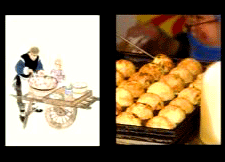
This is the oldest traditional snack street in Beijing and perhaps the best example of the early fast food industry in China. The atmosphere is relaxed and casual with vendor front’s lining each side of the narrow street. Numerous Chinese snacks such as fried bread sticks, tomatoes on sticks, and steamed buns can be sampled here, all scenting the air with a welcoming fragrance. With China’s policy of reform and opening up, the vendors on this street where some of the first Chinese to feel the impact of foreign fast food competition.
Everyday this street is filled with Chinese fast food venders, attesting to the variety and popularity of Chinese fast food. When KFC entered the market in 1987, establishing it’s first location here in Beijing, it was small stores like these were the only competition. Quickly seeing KFC’s success in the market, others like Pizza hut and McDonalds followed suit.
Since the first KFC opened in China in 1987, the image of an old captain, with gray hair and a kindly smile, has become visible in most crowded locations in every major Chinese city. As famous western fast food restaurants quickly established their presence in China, western style foods, such as fried chicken, hamburgers and French fries, began to pose a challenge to China’s locally produced fast foods such as soybean milk and fried bread sticks. Witnessing the sudden explosion of modern western chain restaurants on the mainland, Chinese customers quickly began to adapt to the new western menus.
Restaurants like MacDonald’s and KFC have a long history and strong international recognition behind them. They target children and families when they enter China’s markets. What will it be like decades later? By then, our children will be parents or even grandparents. That means they will have integrated Western fast food into their whole families’ diet..
Indeed, western fast food chains do focus their strategy on the children’s market. They mount promotions designed to be appealing to children. Posters of smiling children cover the interiors attracting both children and their parents. Western fast food chains recognized early on the potential of the Chinese market and have been aggressively working to expand their customer base ever since.
KFC in particular, has experienced explosive growth since it’s entrance into China There are now over 1,300 KFCs in China. Based on extensive market research, KFC decided that in order to better suit the Chinese market KFC needed to adjust the taste of its offerings and make changes to its operational systems. Because of these decisions KFC has grown by 200 to 300 new restaurants every year.
The clarity and accuracy of both MacDonald’s and KFC’s planning and strategy have contributed greatly to their success. Integration of such modern operational modes are critically important to the development of China’s own industries. To some extent, Western fast food management has shaken up the Chinese traditional catering industry.
According to recent statistics, There are over 800,000 fast food chain restaurants in China. The turnover of fast food restaurants will be more than 20 Billion USD this year, accounting for 20% of the entire catering industry. KFC and MacDonald’s account for 7% to 8% of the market while Chinese fast food still makes up the main portion of the market. Despite this, there is not a single Chinese Fast food enterprise which is capable of competing with Macdonald’s and KFC head on.
For a lot of Chinese people, it is hard to understand why the Chinese restaurant market, with such a long head-start and enjoying the advantage of cultural familiarity has been outdone be western fast food companies. What did western fast food bring that was so important? They brought advanced ideas for operation management and even advanced conception of cuisine.
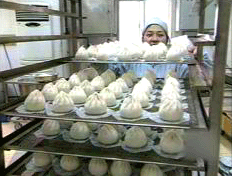
As mentioned earlier, China has many of her own traditional fast food dishes. Of these, Steamed buns, dumplings, fried bread sticks, and noodles are the most common and popular. Seeing the success of Mcdonalds and KFC, Chinese entrepreneurs ambitiously sought to realize the development of Chinese fast food chains to challenge the western newcomers. Incorporating already popular, traditional Chinese fast foods into their menus, they where confident of their success.
10 years ago here in Zhengzhou, one of china’s first fast food chains was established, their goal was to create a brand image capable of competing with western fast food head on.
Zheng Zhou is the capital city of He Nan province and is home to the largest population in China. In 1996, Honggaoliang, the first Chinese chain fast food restaurant was born here.. To this day the chain restaurant is well known in China. It featured braised noodles and soup wich is widely popular in Henan and other provinces.
In Zheng Zhou, noodle restaurants make up the majority of the restaurant business。Noodles are seen as an important part of daily dining in Zheng Zhou, not lightly missed. Braised Noodles are a local favorite in Zhengzhou featuring pleasantly tough noodles in a bowl of delicious and nutritious soup. In downtown Zhengzhou, there are numerous restaurants offering Braised Noodles in different thicknesses, and tastes. Because of it’s simplicity and speed of preparation, braised noodles enjoys a special place in the local fast food market.
Selling braised noodles gave Honggaoliang a competitive edge. It opened its first store in the busiest shopping center of Zheng Zhou. On opening day, it turned a profit of 2,000 yuan. A few days later, it was earning more than 10,000 yuan per day. Initially only 440,000 yuan was invested into Honggoaliang and within 8 months profits of 5 million where realized.
Honggaoliang roughly translates into Red sorghum. Red being the color traditionaly associated with Chinese culture and patriotism. However, Honggaoliang’s logo, a stylized “M”looks strikingly similar to McDonald’s golden arches. These mixed associations in Honggaoliang’s logo reveals a great deal about the respectful yet competitive attitude the Chinese fast food company had toward it’s western competition.
Drawing a great deal from the strategies of MacDonald’s. Honggaoliang created a unique company culture and special uniforms. It was largely considered to have been a great success. It established it’s first cross-regional restaurant in Beijing, moved on to open 20 more chain stores across the country, and at it’s peek boasted more than 40 individual service locations. An ambitious slogan was coined: Where there is McDonald’s, there will be Honggaoliang Braised Nooldles.
|

|
|
|
This slogan aroused great patriotism and national pride in the people’s hearts. Chinese people across the nation loved HongGaoLiang not only because of its delicious noodles but also because it was seen as an example of Chinese business success in the face of international competition. But problems soon emerged as Honggaoliang continued it’s expansion at full speed. Fatal problems developed in capital operation within less than 5 years. On Dec, 31st, 1999, 27 stores in Zheng Zhou were sealed up and the headquarters closed announcing the end of the Honggaoliang company. . What led to the sudden failure of Honggaoliang?
Though Honggaoliang, and other Chinese fast food chains failed in the end, they have had a meaningful impact on the development of the industry. History provides lessons for the present. It is now widely recognized that compared with the giants MacDonald’s and KFC, Chinese fast food is still in an early stage. Chinese entrepreneurs now have a deeper understanding of the steps that need to be taken to develop a healthy Chinese fast food industry. As western fast food chains have quickened their step in expanding business in China, Chinese fast food enterprises are starting again and looking to a bright future. There is now a sense that western fast food and Chinese fast food can successfully coexist in the market.
The struggles and disappointments of the early Chinese fast food chains has been taken examples for newcomers and the industry as a whole to learn from. Now they are looking into western fast food industry as an example while maintaining many of the unique features of Chinese cuisine.
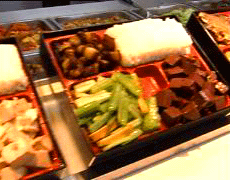
If you make a trip to Shanghai, the largest city in southern China, other than the expected McDonalds and KFCs, you will find there are a large number of Chinese fast food chains, called New Asia Snack. At a glance, they may look like classic western fast food chain stores, but they are actually traditional Chinese snack restaurants with a very western look.