Wandering in Hutong 
cctv.com 07-22-2005 10:10
A memory of the past
The scent of culture
A witness to change
The trail of time
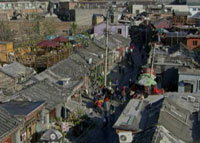
This is a hutong, an ancient city alley typical of traditional Beijing residences. By current estimates, there are several thousand hutongs here; each with its own historical significance.
Compared with the glistening, towering high-rises of recent years, strip after strip of hutong may appear to be nothing more than some dirt and ash, but they actually come from the deepest roots of Chinese culture, and have left a living imprint on Beijing straight through to modern times.
Beijing’s hutong began to appear around the end of the 13th century, and saw history progress through over five centuries with China’s Yuan, Ming, and Qing dynasties. Today, they are like blood vessels to the body of Beijing, tracing tiny routes through every part. There are several theories as to the origins of hutong, but they all relate to the Mongol-centric culture of the Yuan dynasty. As a matter of fact, the word “hutong” comes from the Mongolian word meaning ‘water well.’
Streets this size would never fly where I am from. The people there just aren’t the same size as the residents here.
Beijing’s hutong thrive with the pulse of average people going about their everyday lives.
Today’s hutong still occupy the majority of Beijing’s downtown real estate, with 1 out of 4 city residents making their homes in this style of housing. Every single one conceals a rich history of its own.
This house and all the structures in this block used to belong to a high ranking general in the Qing Dynasty. With the founding of PRC in 1949, a segment of this house became the embassy of Afghanistan.
Just like these events of old, any old Beijing book or website can lead you to the fine points of hutong.
Over the past several years, the unique traditional architectural features of Hutongs have attracted a large number of foreign residents who now make their homes in Beijing. Among those who call Hutongs home are people from places as far flung as France, the US and Germany and several other countries.
In the wake of Beijing’s booming prosperity, more and more foreign citizens are going from being temporary visitors to longtime residents, and as they study or work in Beijing, they’ve gone from hurriedly passing through to being an indispensable part of the Beijing scenery.
Strolling through a hutong at dusk, the streets are alive as residents bustle home from work all around me. Seeing all of these big-city residents greet one another so naturally can have an almost surreal feel to it, as hutong neighbors truly treat one another like family.
We have spent many years in high-rise buildings, Anzhenqiao area of Beijing, fifteenth floor.
We were fed up with pollutions and general problems that go with high rise buildings. In 2000, my wife started to look for somewhere comfortable for us to live, where you can find certain tranquility that you cannot find in high-rise. After a year and a half of investigation, we found this small little place in the Shichahai district, or the Houhai district. And decided this is a place we want to live. In the Houhai area, the neighbors are very friendly.
I can talk to my neighbor, for instance, Laowei, who lives next door and raises pigeons.
I learnt a lot from him about pigeons and see him flying them. I never felt that in the high rise. In the high rise, you go to your department, and there you are. That’s it. Here, it’s a great sense of community, and as I mentioned earlier, tranquility, which I treasure a lot.
You can’t drive a car up to our front door. From my perspective, it’s wonderful because I don’t have any traffic there. My son can go out to the street without me worrying about him to run into a car. Maybe seven or eight years ago, there was a bar that was in the lakefront, called No Name Bar. In the last three years, they have gone from one bar along the lake to, I don’t know how many. That must be 50 hundred bars. That, I am not against. The offset is that you get certain amount of noise, noise pollution in the night. The second thing is that is more worrying to me, more than the government tearing down the courtyard here is the development towards to the inner area of Hutong of touristy shops and joints that don’t contribute to the tourist experience. The problem is that Tourists want to see the original but not the shops. There are other ways of doing the same things that contribute to the Hutong experience. That’s different, that preserves Hutong environment. For example, one of our neighbors up this way has developed a breakfast ditch, It gives you the feeling of Hutong. Clean, nice and it has a courtyard, and trees. Those things are okay. But, if that sort of commercial aspects of bar district, tourist shops come in, it’s very bad.
I think the most important aspect of living in a Hutong is the feeling that you are part of a village. Beijing has 13 million people, traffic and noise. When I come home from work, I almost come to an island of tranquility. That’s for me the most important part of living in Hutong.
Beijing served as the imperial capital for three dynasties, and each emperor made his regal home in the center of the city. Hutong developed out of this tradition, and radiated out of the palace in four directions. The main architectural style that organizes hutong is almost strictly that of the traditional courtyard, or, “box” style that has come to represent the residences of Beijingers throughout the ages.
Because of the strict class system present in China’s feudal history, the ruling class decreed that area to the east and west of the Imperial Palace could only be occupied by blood relatives of the imperial family. Land to the north and south of the palace was reserved for the merchant and peasant classes. Because of these distinctions, the courtyards in each area of Beijing have their own unique features.
It stands to reason that understanding of a city’s history leans with fully understanding the city’s present. The fundamental part of understanding Beijing’s history is understanding Si He Yuan, or the traditional courtyard.
“Traditional” or “four-walled” courtyards were designed and laid out in strict accordance with square patterns that fell strictly along lines of due north, south, east, and west.
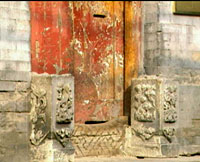
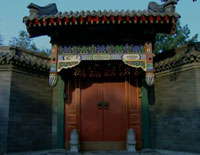
In feudal society, people didn’t hesitate to spend large amounts of money renovating their homes. On the exteriors of Beijing homes, people loved pairing bright reds and greens to form intricate patterns on the eaves and awnings. The motifs of these designs were many, including historical figures, plants, and birds – anything the owner desired.
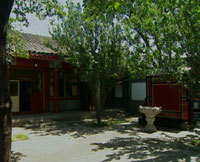
This is a typical courtyard in Beijing’s East District. The residents of this home are an international couple: the husband, a modern art dealer with his own gallery; and the wife, a journalist for a major French weekly magazine.
Hutong and courtyard are so special to China and also to Beijing. You can’t find it anywhere else. I also think that courtyard constriction is adapted to the ways of Northern China, where it is pretty cold in winters, and windy. Because you have all the walls around. That curbs the wind. SO, you can use a garden for very long time of the year normally from the beginning of April to the end of November. This is something really good. This is a very special way of life to be in the city but with the feeling of the countryside.
In the ideas of mixture, maybe it is more or less what we have in mind. That’s the expression here. Each of us wants to keep their own identity. And then we mix it, and there is something new. Maybe the story of this piece is very funny because it came during the night and because It is impossible for the mixture to get into the city during the daytime. We have a lot of problems to put it through the gate. The day after we came to look at it. They said what is that. It is very difficult for them to understand it. But, Chinese people are very open-minded. They can accept a lot of new ideas.
Once called “the SOHO of Beijing’s eastern suburbs” by the New York Times, this space was originally known as Factory 798: a 1950’s and 60’s workshop built with the assistance of the Soviet Union and German design.
It is said that once the factory went up for rent, it was actually a Tokyo art gallery that took the lead is transforming this area into what is has gradually become today: a virtual playground for all kinds of modern artists, complete with its own design, publishing, exhibition, performance, and creative spaces.
Perhaps surprisingly in this atmosphere of all the greatest works of modern Chinese artwork and culture combined together in one place, you can also find shadows of some of Beijing’s most traditional culture, hutong, mingling among the featured works.
The terracotta roof, the wall, the doorways, all of those are typical Chinese, but actually they were painted by Frenchman and seen through Frenchman’s eyes.
Charles Chauderlot never sees enough of the small alleys called “Hutong” in Chinese. Here, he encounters residential houses, some built over 300 years ago. Carefully decorated roofs and gates dominated Beijing during the last dynasties. With a touch of history, they are irresistible to a painter.
6 years have passed since Chauderlot landed in China and picked up a Chinese brush to depict eastern beauty.
One after another, Chaudlerot’s pictures record the different faces of Hutongs and yards that have been cast aside in lieu of more modern structures. After 5 years working in the old city, he was invited to paint the largest yard and house in China—the Forbidden City, the Imperial Palace for two dynasties and home to 24 emperors. It’s a privilege not enjoyed by any other foreign artists.
The huge palace reminds him of Versailles. Though the two architectural miracles may have shared the same glory and gunfire, their structural philosophies are very different.
Walls, walls, Walls everywhere. Many foreign painters can’t understand why the Chinese, from emperors to civilians, are willing to be confined by walls. Learning from Chinese painting, they always leaves some blank areas on his paintings, as spaces allowing for the imagination to wander. For the painter who has seen everything in the residential alleys and emperor’s palace, something about the old city of Beijing still remains a mystery.
Tearing down has, in effect, become the first stage in Beijing government’s push to internationalize. With this approach, thousands of ancient alleys have been lost to the indiscriminate roar of bulldozers.
Because of the constant changes taking place at the end of the 19th century in Chinese society, the courtyards in Beijing’s hutong likewise began to experience great change. More and more people moved into these homes, and space became extremely cramped. Buildings fell into disrepair, and the old was unceremoniously replaced with the new.
Many of Beijing’s old streets have become indistinguishable from their counterparts in Paris, New York, London, Singapore, or L.A. – in many places, what was once unique has been lost.
As Siheyuans have begun to disappear, the cost to rent an old one has skyrocketed. Where is this used to be gathering places for average men of letters, as much as 10,000 US dollars a month to rent, this courtyard is far out of reach for the average person.
In recent years, to protect hutong culture, one approach the Beijing municipal government has taken has been that of allowing people to purchase entire courtyards, and then individually restore the spaces according to original traditions. This has served to maintain the general landscape that the older courtyards once formed. The city already has more than 25 hutongs that have been given protected status. For the remainder of hutong communities, the government is working to improve the overall quality of the infrastructure and facilities in order to raise the standard of living for common hutong residents.
Traditional courtyards have been, currently are, and promise to be the dwelling places for masses of Beijing residents in years to come.
Out of over 13 million Beijing residents, one in four own a bicycle, which, in Beijing, is seen as the cheapest, most convenient means of transportation. Equipped with a bicycle, you can truly get a feel for the way of life in an ancient city. And through the camera lens, the tip of a pen, or the eyes of a friend, you can add depth and accuracy to your perception of this ancient capital.
That’s really traditional. This has not been renovated at all. But, I think it is really a pity that it doesn’t seem to be either destroyed or left like this or left to rich people to renovate it. There should be a way of helping the poor people who live here to improve their living conditions by staying here because I think it is the culture of Beijing.
Beijing faces the unenviable challenge of preserving its impressive history while creating the trappings of a modern city. How can the special charms of Hutongs be honored and maintained? How can the importance of this consideration be instilled to the next generation? We hope that this program gives you more ways of thinking about these questions and another angle from which to appreciate Chinese history. Thanks for watching this edition of Rediscovering China. I am Eve Bower.
Editor:Hu Source:CCTV.com